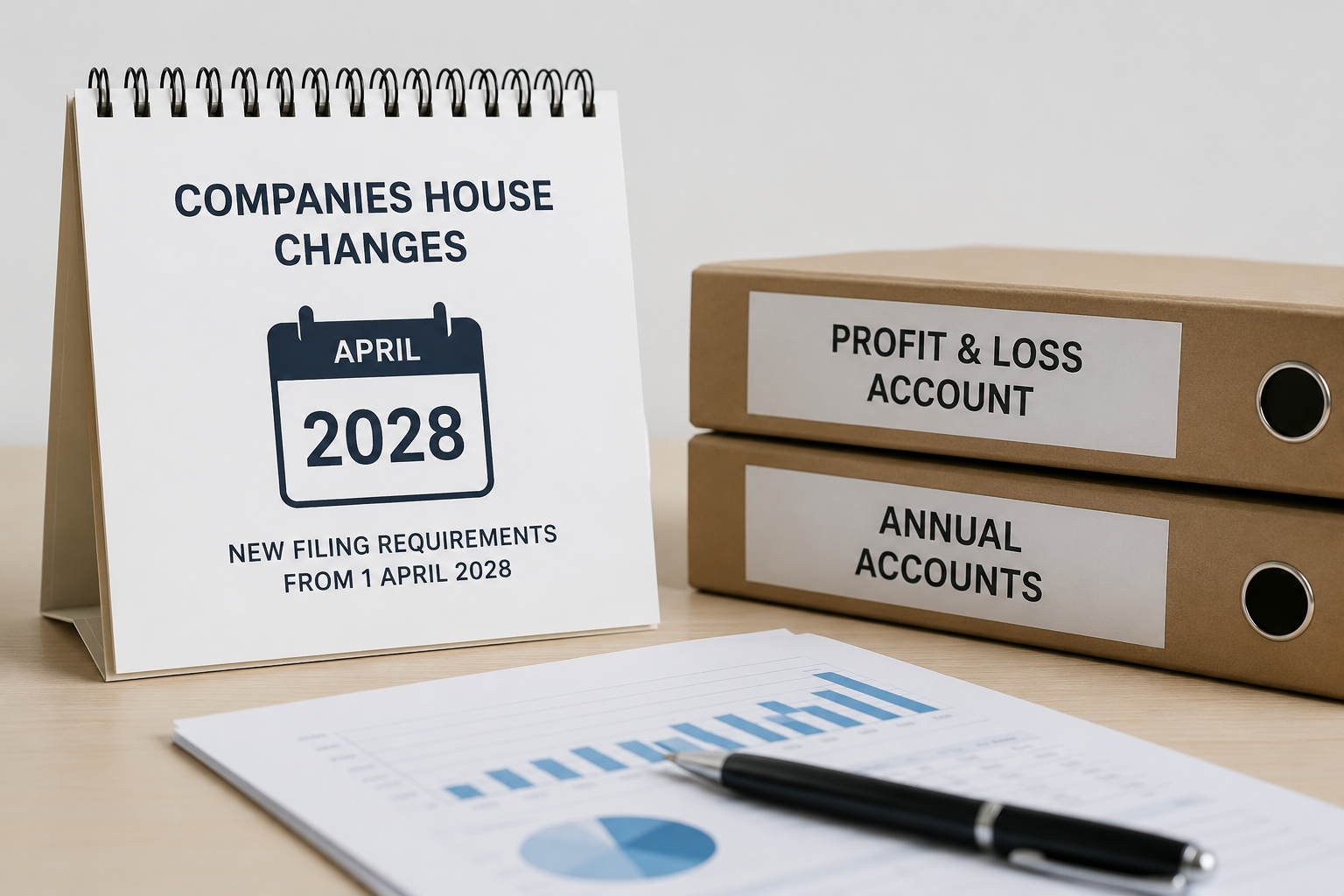
Greater Transparency for Small Companies: What the 2028 Companies House Changes Mean for Your Business
If you operate a small limited company, an important change to Companies House filing requirements is approaching. From 1 April 2028, many small and micro-entity companies will need to submit their Profit & Loss (P&L) Account as part of their annual accounts filed with Companies House.
This represents one of the most significant changes to company reporting requirements in recent years. For many directors, it means greater transparency, increased scrutiny of company filings, and a stronger emphasis on maintaining accurate financial records throughout the year.
The changes form part of the Economic Crime and Corporate Transparency Act, which is designed to improve the accuracy and reliability of the UK company register while helping to combat fraud and economic crime.
What Is Changing?
Under the current rules, many micro-entity and small companies are able to file simplified accounts without including their Profit & Loss Account on the public register.
From 1 April 2028, this will generally change.
Small and micro-entity companies will usually be required to submit additional financial information to Companies House, including their Profit & Loss Account as part of their annual accounts.
The reforms are intended to provide Companies House with a more complete understanding of a company’s financial position and improve the quality of information held on the UK company register.
Why Are These Changes Being Introduced?
The UK Government is strengthening Companies House through the Economic Crime and Corporate Transparency Act to make company information more reliable and to improve trust in UK businesses.
The main objectives include:
- Improving transparency across the company register.
- Reducing opportunities for fraud and financial crime.
- Increasing confidence for investors, lenders, suppliers and customers.
- Improving the accuracy of information submitted to Companies House.
- Giving Companies House greater powers to review and challenge inaccurate filings.
These reforms are designed to create a stronger and more trustworthy business environment for everyone.
What Does This Mean for Directors?
Although filing requirements are changing, directors’ legal responsibilities remain exactly the same.
Every company director is responsible for ensuring that annual accounts are complete, accurate, and submitted on time.
As Companies House begins receiving more financial information, directors should expect:
- Greater scrutiny of company accounts.
- Increased validation checks before filings are accepted.
- More questions where accounts appear inconsistent or incomplete.
- Greater importance placed on accurate bookkeeping and financial reporting.
Preparing accounts carefully and maintaining good financial records throughout the year will help reduce the risk of delays or compliance issues.
Why Accurate Bookkeeping Matters More Than Ever
The upcoming changes highlight just how important bookkeeping is to every business.
When financial records are kept accurately throughout the year, preparing annual accounts becomes significantly easier and less stressful.
Good bookkeeping helps businesses:
- Produce accurate Profit & Loss Accounts.
- Prepare statutory accounts efficiently.
- Monitor business performance.
- Maintain reliable financial records.
- Reduce errors before submission.
- Meet Companies House and HMRC obligations with confidence.
Instead of leaving bookkeeping until the year end, businesses should aim to keep their accounts updated regularly. This not only improves compliance but also provides valuable insight into how the business is performing throughout the year.
An Example
Imagine a small limited company that currently qualifies as a micro-entity.
Today, it may only file a Balance Sheet with Companies House while keeping its Profit & Loss Account private.
From April 2028, that same company will generally also need to submit its Profit & Loss Account as part of its annual filing.
This gives Companies House greater visibility of the company’s financial performance and reinforces the importance of maintaining accurate accounting records throughout the year.
How Can Businesses Prepare?
Although the changes do not come into effect until April 2028, businesses should begin preparing well in advance.
Some practical steps include:
- Keep bookkeeping records up to date.
- Record all income and expenditure accurately.
- Store invoices, receipts and supporting documents securely.
- Reconcile bank accounts regularly.
- Review accounting procedures each year.
- Seek professional advice where necessary.
Businesses that already maintain organised financial records are likely to find the transition much easier.
How Business Management Consultation Can Help
Preparing for new filing requirements does not have to be overwhelming.
At Business Management Consultation, we help businesses stay compliant with both Companies House and HMRC requirements by providing reliable accounting and bookkeeping services.
Our services include:
- Preparation of statutory annual accounts.
- Bookkeeping and financial record keeping.
- Profit & Loss Account preparation.
- Corporation Tax compliance.
- Companies House filings.
- HMRC reporting.
- Ongoing accounting advice and support.
Whether your business is newly incorporated or well established, we can help ensure your accounts are accurate, compliant and ready for the new filing requirements.
Frequently Asked Questions
Will every small company need to file a Profit & Loss Account?
Most small and micro-entity companies are expected to be affected by the new filing requirements from April 2028, although businesses should continue to monitor official guidance as implementation approaches.
Will these changes affect Corporation Tax?
No. HMRC already receives detailed financial information through Corporation Tax returns. These changes relate primarily to information submitted to Companies House.
Is there anything I should do now?
Yes. Improving your bookkeeping processes today will make complying with the new filing requirements much easier when they come into effect.
Conclusion
The Companies House reforms taking effect from 1 April 2028 represent an important step towards greater corporate transparency in the UK.
For small companies, the requirement to submit a Profit & Loss Account means that accurate bookkeeping and professionally prepared annual accounts will become even more important.
Rather than waiting until the changes take effect, now is the ideal time to review your accounting processes and ensure your business is ready for the future.
If you would like advice on how these changes may affect your company, Business Management Consultation is here to help.
Call us on 01273 777 333 or contact our team today to discuss your accounting and compliance requirements.




Leave a comment